Instrument maker brings history alive with music
By Alan Madlane
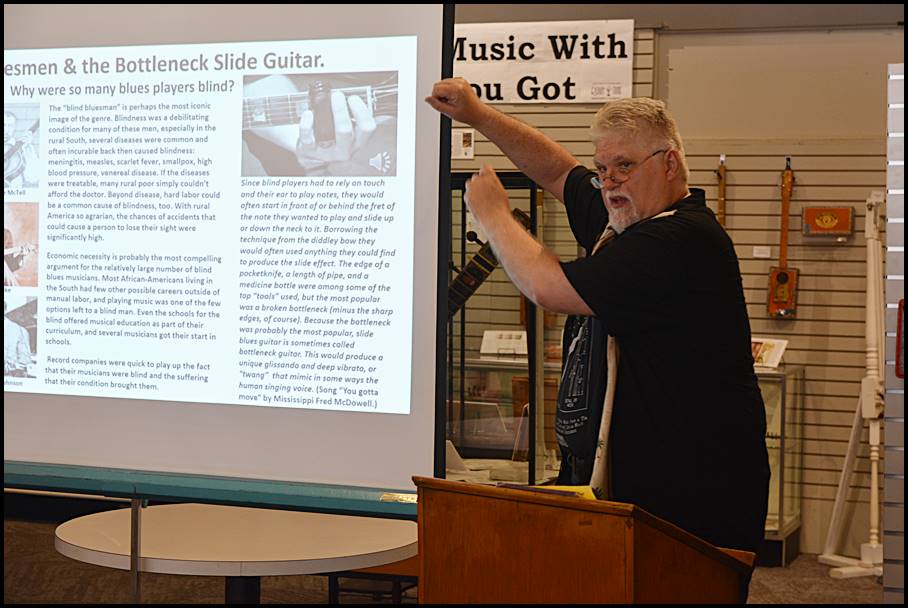
Recently, Michael Copado shared his knowledge of folk instruments throughout the ages, and from various cultures, in a lecture on his homemade instruments, and the origins of their roots, on June 28 at the Hamtramck Historical Museum.
We caught up with Copado to talk more in-depth about his passion.
The Review: Let’s start with a little bit about you: Were you from the Hamtramck/Detroit area initially, or not?
Michael Copado: I was born and raised in Warren.After moving around the Detroit metro area, I ended up living here in Hamtramck the first time around 2000, while I was attending Unity’s Detroit Urban Ministerial Program. From 2002 to 2003, I attended my final year of seminary training at Unity’s Headquarters at Unity Village, Missouri.
I’ve been all over the state, as well as Florida (which I hated) and Missouri (which, outside of Michigan, I loved).
The Review: What other work or hobbies have you done, or do you still do, along with making the instruments and your ministry?
Copado: I have also worked in cable television production, freelance photography and radio, including at WDET-FM, where I did sound engineering and also co-produced music shows such as “Detroit Jazz Alive” and “Blues from the Lowlands.”
Other hobbies: “Internet-famous” home brewer for over 20 years; credited with rediscovering the lost Civil-War-era beer style known as “Kentucky Common.”Now, most of my hobby energy goes into building instruments of all sorts, including electronic ones such as effects pedals and synthesizer circuits, though mostly I prefer stringed instruments, both historical and experimental.
The Review: What prompted you to get into making your own musical instruments? What materials do you use?
Copado: Over 30 years ago, I was involved in the drum circle and mythopoetic men’s movement, and I got interested in making my own African-style drums, as well as bamboo flutes, but always thought (not knowing the history of these instruments) that things like guitars and other stringed instruments were made by some special class of elites known as “Luthiers.”
In fact, until seminary I subscribed to a magazine called “Experimental Musical Instruments Magazine.” I let it lapse (along with my hobbies) while working full time and going to seminary.
Shortly after I cancelled, they did a feature on the history of, and how to build, cigar box guitars, featuring a young college kid named Shane Speal, who would later be dubbed “King of Cigar Box Guitars.”
It would be through Shane’s work and, 20 years later, the internet that I would discover these instruments, but also their history — which (like most of my interests, such as the history of brewing and vintage base ball, which I am a part of founding) is set in that same period, sort of post-Civil War through Prohibition (late 1860s through the early 1930s).
Back when I was younger, I tried learning conventional six-string guitar; even had Robert Jones at WDET, one of the most prominent acoustic blues historians and performers, try to teach me, but I could never manage it.
Looking for something to fill the down time between steps in brewing, I thought, “Maybe since we now have YouTube and online lessons, I could get a cheap guitar at a pawnshop and watch videos and try to learn.’
And, literally the next day, a random YouTube video popped up of Shane Speal talking about, and showing how to build, cigar box guitars.
As to materials, I use whatever inspiration (or history) leads me to. Initially, a lot of my guitars are made with cigar boxes — like they traditionally were, once Abraham Lincoln enforced a tax on tobacco products to fund the North’s army in the Civil War.
In order to protect them from dampness, the manufacturers put the cigars into boxes made of Spanish cedar, which made the boxes appealing to sell. This was one of the first instances of product packaging as advertisement.
At the same time, after emancipation in the South, we had former slaves working as sharecroppers who had a cultural understanding of the fact that the roots of all stringed instruments that we know today came from the African mouth bow.
These evolved into lutes, then banjos, fiddles, guitars – everything — but they often couldn’t afford modern commercial instruments, and so instead played very crude single-string instruments such as the diddley bow, which was (at first)two nails driven onto a door frame with a length of broom wire strung between, a couple of bottles or rocks wedged under the strings to tighten them, and then was played by striking it while running a bottle neck over the strings to add color to it (where we get the slide sound of the blues).
When they needed it portable, they took a broomstick or a hunk of fence post and did the same thing, but it wasn’t very loud. Especially if you’re trying to make money on a street corner playing music. (Editor’s note: Think Creedence Clearwater Revival’s “Willy and the Poor Boys”).
Or, they played an upright bass called a “gut bucket,” which evolved from the African ground bow.
What was important about these cast-off cigar boxes was that they were made with Spanish cedar — the same material the finest guitars of that time were made of.
So, they figured out that if you (outfitted) your broomstick or fence post with one or a couple broom wires, window screen wire or even the hair from a horses tail, you had a crude yet very playable guitar, and eventually if you got recorded (or made enough playing juke joints) you could afford a modern multi-string guitar.
As I show in my presentation, just about every person thought to be a “forefather” of their musical genre, whether it was Carl Perkins for rockabilly, Roy Clark for country, Eddie Lang for jazz, George Benson for smooth R&B, pretty much every early bluesman (Little Freddie King of New Orleans is one of the last living legends of the blues that talks about this) or even, yes, Jimi Hendrix, got their start playing music with a homemade cigar box-type instrument.
So, a lot of times it is just an interesting box or cookie tin that inspires me. Other times it could be something like an antique hinge off a cupboard that I think would make a cool tailpiece, and I might build an instrument around that.
The Review: If we’re talking about found items, what do you look for in an object that tells you it could possibly be turned into a good instrument? Are you willing to say where you find, or look for, your found objects?
Copado: If I am making an acoustic instrument, then obviously it has to have a certain level of acoustic resonance; it has to sound good when you hit it, for example. Like I mentioned, a lot of the early ones (and some to this day) were made with the same wood as fine guitars.
Really, anything works. I use cookie tins for banjo-like instruments, but wooden bread bowls, big salad bowls work great too.
In the museum, I pair a banjo made from an antique pie tin, using plans from a 1920’s diagram from Popular Mechanics magazine, with a “cigar box guitar” made from internet plans, actually using the cardboard box from an Apple iPad.
If I’m making electric instruments like guitars or lap steels or diddley bows, anything works. I’ve used a decorative canoe paddle ornament for an electric diddley bow, and also, in the exhibit, is a three-string slide guitar made with a vintage Kresge’s metal clothing washboard.
I find stuff everywhere. Resale shops, second-hand stores, garage sales, people’s basements. Most of the instruments on display have at least one part in them from somewhere here in town, often from something found in an alley.
For example, I recreate an instrument known as a “Vaudeville fiddle” (as played by W.C. Fields) out of an ornate leg from a broken table. For fret boards on my guitars, I will often use the lathe wood from the lathe and plaster walls of these 100-plus year-old homes that I’ll pull out of the trash when I see one of my neighbors is remodeling.
The Review: What is the full range of musical instruments you are currently making, or have previously made? Any plans to expand into other areas, either different types of instruments or even non-instruments?
Copado: This year I have been focusing primarily on historical instruments. Many of them the single-string variety.
Right now, I am building the three primary roots instruments that originated in Africa that became the banjo as we know it today: the nagoni, the guembri and the akonting.
Side note: the akonting players were often among the first people in Africa stolen (enslaved) — they were forced to play music on the deck of the ships while other enslaved people were forced to dance for “exercise” to keep them alive on their horrid transatlantic journeys.
This instrument, once it landed in the Americas, became what would eventually be the modern banjo.
A lot of my interests these days are in the various single-string instruments around the world, especially those of the ethnicities that currently make up “The World in Two Square Miles” that we inhabit.
I build and play instruments primarily on my porch in the summer, so the neighbor kids would tend to gather around me and ask questions and ask (me) to play.
When I first moved back here and started building, usually the Bengali kids on my side of the street would come over, but when the Yemeni kids from across the street would come, the Bengali kids would disappear.
So, I started researching the instruments of both of their cultures, so that when one group of kids would start to leave, I’d say “Hey, wait a minute, do you know that you have a single-string instrument in Bangladesh called the ektara (in India, the gopichand) which may be where the idea of the wah-wah pedal for electric guitars comes from?
“Because when you squeeze the two bars that support the string, it’s the same effect of making the string make a ‘wah’ sound, and did you know that, in Yemen, you have a single-string instrument called the rebab that came from the Bedouins?
“But you look all around the world, they’ve pretty much modified it, depending on where your people were. Like when it got to Andalusia in Spain, where my family originally came from, you modified it in such a cool way that you then took it to medieval Europe where it became what is now: the violin?”
The kids would stick around, asking more questions, and I’ve noticed, over the years now, that these kids are playing together more instead of in separate groups, so I feel like I’ve helped a bit with bringing that together on my street.
I have built a coffee can ektara, which is in the exhibit, along with a traditional one from Bangladesh. I’ve also built a cigar box instrument called a drone of mode (the original instrument developed by a New Orleans-based cigar box world-music musician and instrument builder named Brett Gardner), that is basically a cigar box sitar; it’s in the exhibit with a full-sized one.
I recently built an electric version of the Vietnamese dan bau, which is like a single-string, planked diddley bow with a built-in whammy bar.
Next on my build list, after the akonting and guembri, I am going to embark on making a single-string instrument from each of the cultures represented on the Hamtramck Historical Museum’s murals — from a Native American bow instrument all the way to the rebab of our Yemeni neighbors.
There are some really interesting ones in our immigrant history. For example, in Germany there is the bumbass or “bladder fiddle,” which is like a single-string cello, but it uses an inflated animal’s bladder as a resonator to increase the volume (I’m going to use a balloon).
Or, from Poland, there’s the diabelskieskrzypce (Devil’s fiddle) which is a stand-up, single-string instrument that has a devil’s face at the top, and may also have a bladder resonator. And there are many more such instruments.
The Review: Have you sold many so far? Has anyone “known” in the industry bought one (or more)?
Copado: I’ve been selling some over the years. I do shows on occasion; I did the Hamtramck Christmas Market two years ago, but most of my inventory has been tied up in the exhibit.
I’ve sold to a lot of local musicians.
The Review: Do you have a website where potential buyers can shop your wares?
Copado: I have both the YouTube channel mentioned earlier, as well as a Facebook page: facebook.com/RevvyTone
I don’t sell online. I tend to believe that each of my instruments has a unique voice, and “feel,” that a potential buyer will be drawn to. And that can’t be “felt” online.
Whenever I’m selling at an event, or if people contact me wanting an instrument, I encourage them to play whatever I have for sale and buy what speaks to them.
The Review: Any notion of collaborating with any other artisans in the future? Any plans to teach others how to do what you do?
Copado: Most of the collaborations that have happened haven’t been about creating instruments, but there are some musicians in town that have expressed interest in using these instruments in recording sessions or live concert settings.
I teach all the time how to make these types of instruments. During the pandemic, I taught a virtual class on the history of these instruments and how to make them, via Zoom, to a class at Kosciuszko Middle School.
The company I buy a lot of my parts from provided me with “canjo” kits (a single-string guitar made with a can of some sort as the resonator) and the kids attempted to build them online.
I’m always looking for more opportunities to teach, especially to school kids. Part of this is about turning things we normally throw away into something new and fun.
It’s also about history (especially, in this town, of the music and instruments of this melting pot of a city and country), and when I teach in schools, I have a STEM part of the class, that gets into how sound works, how our ear converts vibrations in the air to the electronic signals in our brains, as well as a little bit of math and physics involved.
I really would like to get a grant, perhaps a Kresge foundation one, that would allow me to do these sorts of workshops and classes around the area, to all different age groups, adults and kids. I would really like some help with putting these sorts of grants together. I have no experience in this matter.
On a side note: Over the years, the kids in town will ask me to give them an instrument, and I have to explain that these aren’t toys, and that they take time to build, but if they’d like to learn then I would provide all the materials and teach them to use my tools and help them build their own.
I point out that they have to commit the time to do it, that it could take a few hours each week for a month, and some of it is boring, and time-consuming. So far, only one person has taken me up on it; back in 2022, a young Bosnian boy from the next block over asked if I’d teach him.
And, for about a month, he built his own guitar. I cut one piece of wood on my table saw and used my drill press to drill the holes for the guitar tuners, but everything else he did, from shaping the guitar neck by hand to sanding every piece of wood; he learned to solder the electronics; and he took the cigar box home and drew on it and then came back and used a wood burner to permanently etch his art on his instrument; then he proudly put it all together.
The Review: How did you get hooked up with the Hamtramck Historical Museum for your presentation?
Copado: Joe Kochut, from the museum I believe, came to one of the Hamtramck Neighborhood Art Fair setups I did on my porch a few years back. Then, he bought a couple of my instruments for gifts for (other) people. Last spring, he asked if I’d be interested in doing an exhibit which then went up last October.
The museum kept extending the exhibit, and we decided a talk would be nice to do.
(This interview has been somewhat edited for length.)
Posted July 10, 2026